Choose the right access point
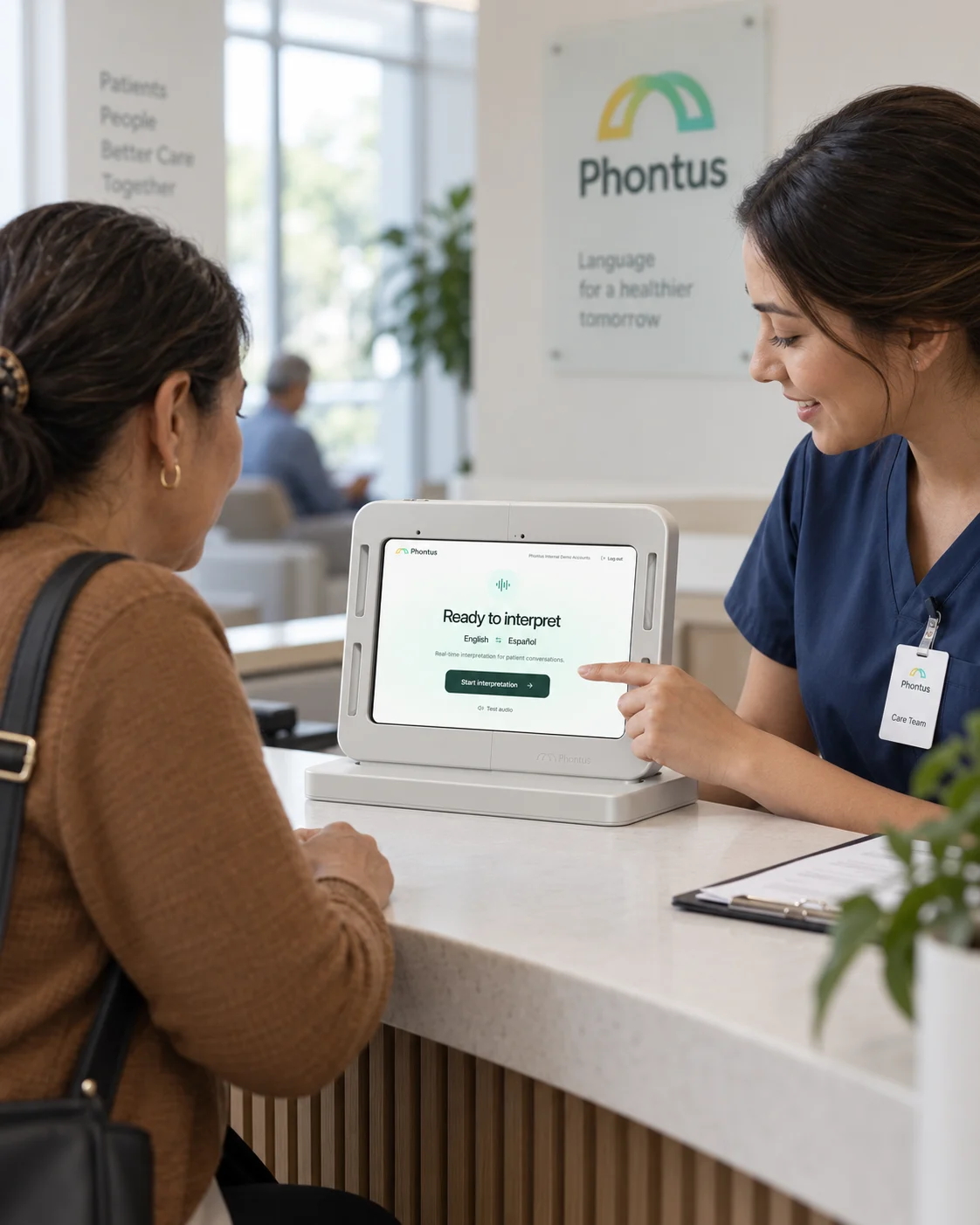
Begin with the mobile Clinical Kit, compact Frontline Kit, or the Phontus Phone Line based on where the conversation is happening.
How Phontus works
Begin from the Clinical Kit, Frontline Kit, or the Phontus Phone Line. Phontus keeps the Spanish–English exchange clear so your team can stay focused on the conversation.
From connection to conversation
Choose the access point for the setting, get connected, and follow a consistent turn-by-turn exchange.
Begin with the mobile Clinical Kit, compact Frontline Kit, or the Phontus Phone Line based on where the conversation is happening.
For a kit session, each participant uses an open-ear bone-conduction headset. Confirm Spanish and English, then begin without creating a separate participant account.
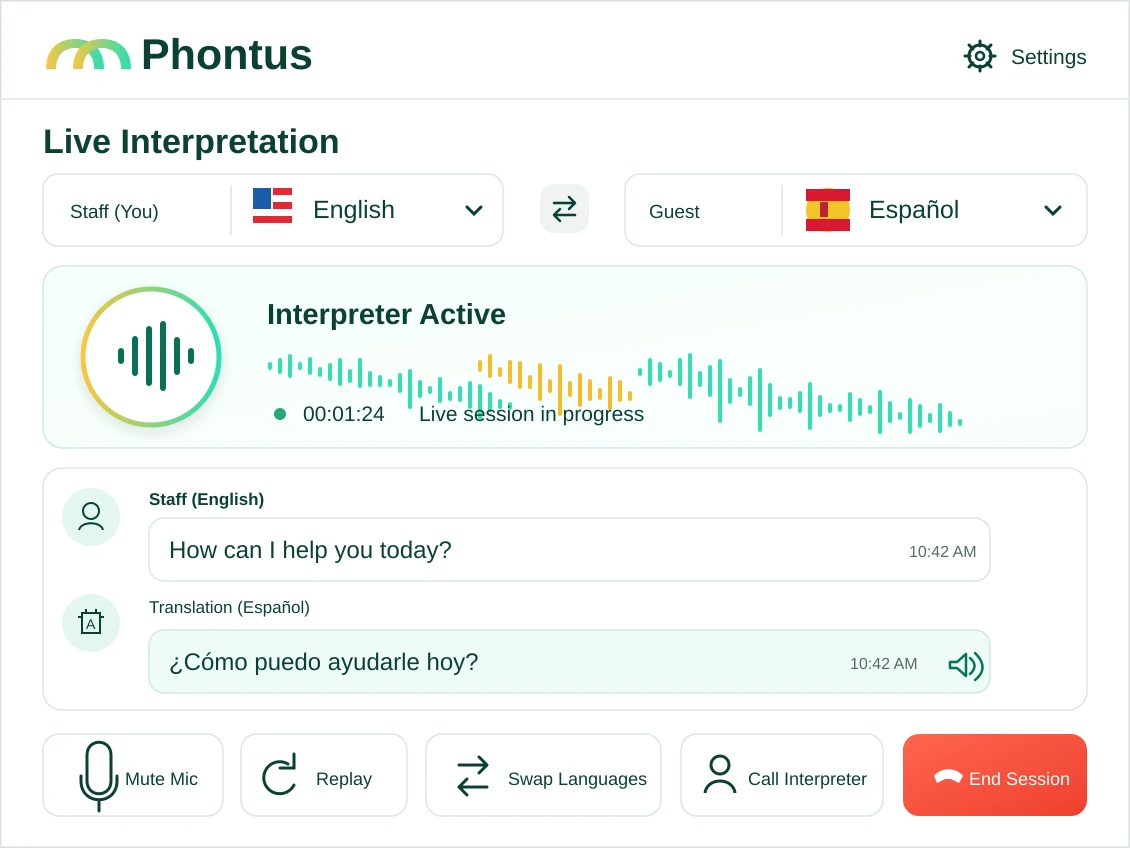
Clear speaker and language cues help both people follow the interpreted exchange until the interaction is complete.
Choose how to connect
The Clinical Kit moves between hospital and clinic spaces. The Frontline Kit fits counters, offices, and worksites. The Phontus Phone Line lets customers reach your team by phone, wherever they’re calling from.
Steps two and three
Speaker labels, language labels, and translated turns form a clear bilingual record of the active exchange. The transcript concept is designed to support orientation, not pull attention away from the conversation.
Deployment
The product workflow is only one part of responsible implementation.
Match Clinical Kits, Frontline Kits, and the Phontus Phone Line to each team and environment.
Plan placement, charging, headset storage and handling, cleaning, and phone availability.
Set expectations for appropriate use, turn-taking, and session handling.
Maintain pathways to qualified human interpreters when a complex or high-stakes situation calls for one.
Frequently asked questions
Phontus is launching with Spanish and English. Additional languages are not currently available.
Organizations can use the mobile Clinical Kit in hospitals and clinics, the compact Frontline Kit in routine service and workplace settings, or the Phontus Phone Line when a customer calls your business number directly.
Both kits pair the Phontus session experience with two open-ear bone-conduction headsets. The Clinical Kit uses a mobile cart with organized storage and space for cleaning supplies; the Frontline Kit uses a compact tabletop format for counters, desks, offices, and worksites.
The headsets leave the ears uncovered and give each participant a dedicated way to follow the interpreted exchange while staying engaged with the person and environment around them.
No separate participant account is required to join a kit-based session.
No. Phontus provides AI-assisted Spanish–English interpretation for appropriate routine interactions. Organizations should keep clear policies for when a qualified human interpreter is needed, especially for complex, sensitive, or high-stakes conversations.
Phontus is designed for routine frontline conversations across healthcare, business and field operations, schools, hospitality, and similar service environments. The right mix of Clinical Kits, Frontline Kits, and the Phontus Phone Line depends on the organization’s workflows, privacy needs, physical spaces, and escalation policies.
A closer look at Phontus
Tell us where language barriers show up. We’ll tailor the demo and explore the right mix of Clinical Kits, Frontline Kits, and phone access for your setting.